Putinism on Full Display: Russia Attacks the “Birthplace of Russian Orthodoxy”
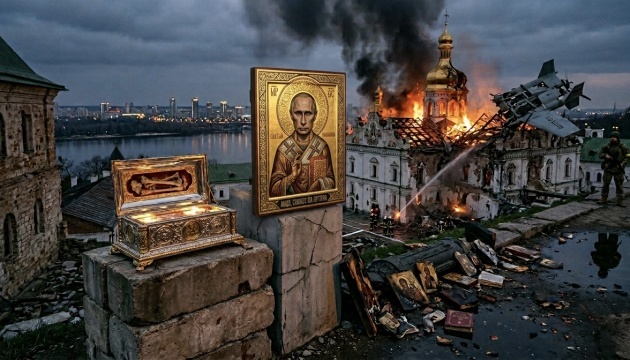
In December 2012, shortly after securing a third presidential term, Vladimir Putin addressed a gathering of his confidants and offered a striking comparison: he equated Lenin’s Mausoleum with the Kyiv Pechersk Lavra.
“They say the Mausoleum does not conform to our traditions. But why? Look at the relics in the Kyiv Pechersk Lavra and in other monasteries... Of course, we need to return to our roots,” Putin declared with characteristic solemnity.
Yet this attempt to place the incorrupt relics of Christian saints on the same sacred plane as the embalmed body of a militant atheist—under whose rule churches were destroyed and clergy persecuted—was only the beginning. At the time, few recognized it for what it was: the symbolic laying of the foundation stone for one of the Kremlin’s most ambitious ideological projects—the replacement of canonical Christianity with a new state creed, “Putinism.”
Putin’s remarks revealed a deeper truth. For the Kremlin, the Kyiv Pechersk Lavra was never merely a sacred site; it was a geopolitical asset. By June 2026, it had effectively been recast not as a “spiritual center,” but as a “decision-making center.”
The Font, the Cradle, and Stolypin
Within Moscow’s doctrine of the “triune Russian people,” the Kyiv Pechersk Lavra occupies a central place. Both Putin and Patriarch Kirill (Gundyayev) have repeatedly described it as the “baptismal font and cradle of Russian Orthodoxy.”
The logic is quintessentially imperial: because the monks Anthony and Theodosius founded a monastery here in the eleventh century, Russia claims an exclusive spiritual inheritance from it. In the Kremlin’s worldview, this historical connection is enough to transform one of Ukraine’s most revered religious sites into an integral part of Russia’s civilizational narrative.
Stolypin and the Dictator’s Personal Obsession
There was also a deeply personal element to the Kremlin’s fixation on the Lavra. Buried within its grounds is Pyotr Stolypin, the fiercely imperial Russian prime minister whom Putin has long regarded as a political role model.
In July 2013, during celebrations marking the 1,025th anniversary of the Baptism of Rus', Putin made a highly symbolic pilgrimage to Stolypin’s grave, where he demonstratively knelt in tribute. It was, in a sense, a political coming-out. Putin was bowing not before the relics of saints but before the remains of an imperial statesman. The gesture carried a clear message: for him, the Kyiv Pechersk Lavra was not merely a sacred site but a pantheon of lost imperial grandeur.
“Returning to the Roots” with Missiles
By June 2026, Putin had risen from his knees and, in his own way, “returned to the roots.”
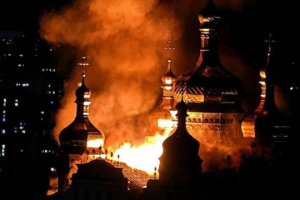
Following a Russian strike, a fire broke out in the Dormition Cathedral of the Kyiv Pechersk Lavra. The response from Russia’s propaganda machine was entirely predictable. State media and pro-Kremlin commentators quickly reverted to a familiar refrain: Ukraine was to blame. According to their narrative, the damage had been caused by Ukrainian air defenses.
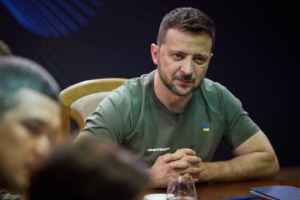
Perhaps the most bizarre claim came from Kremlin loyalist commentator Sergey Markov, who argued that “Volodymyr Zelensky personally waited for the Russian strike and then, under its cover, set the monastery on fire from the inside.”
Yet this pattern has accompanied virtually every major Russian attack on Ukrainian religious sites. The cynicism is striking—almost ritualistic in its consistency.
Since the start of the full-scale invasion, Russian forces have damaged or destroyed more than 700 religious buildings across Ukraine. Among the hundreds of affected churches, monasteries, and houses of worship, several stand out for their historical and cultural significance.
One of the most notable examples is Odesa’s Transfiguration Cathedral, originally founded at the end of the eighteenth century. The cathedral had already suffered destruction once before, having been demolished by Soviet authorities and painstakingly rebuilt after Ukraine regained independence.
On the night of July 23, 2023, a Russian Oniks anti-ship missile struck the cathedral directly. The attack destroyed the main altar, severely damaged the interior, and devastated multiple levels of the building, leaving one of southern Ukraine’s most important religious landmarks badly scarred.
Russia’s full-scale assault on Ukraine’s historic lavras began with the Holy Dormition Sviatohirsk Lavra in the Donetsk region. From the spring of 2022, the monastery found itself on the front line and came under dozens of Russian attacks.
Among the most devastating losses was the destruction of the magnificent All Saints Skete—the largest wooden church in Ukraine, built entirely without nails—which burned to the ground. Russian shelling also damaged the Lavra’s main Dormition Cathedral, monastic quarters, and bridges. Several monks, nuns, and civilians were killed on the monastery grounds.
One of the earliest religious landmarks to fall victim to Russia’s invasion was St. George’s Church in Zavorichi, in the Kyiv region. Built in 1873, it had survived both World Wars as well as the Soviet anti-religious campaigns. Yet in March 2022, during Russia’s failed offensive against Kyiv, the church was deliberately shelled by Russian tanks and burned to the ground. A similar fate befell another unique nineteenth-century wooden church—the Church of the Ascension in the village of Lukianivka.
Russian forces employed an equally destructive, and distinctly Soviet-style, approach in the village of Lukashivka in the Chernihiv region. There, they converted the local Church of the Ascension into a storage site for ammunition and fuel, while military vehicles were parked in its courtyard. During the fighting to liberate the village, a major fire broke out inside the building. By the time the battle ended, little remained beyond its scorched walls.
Kharkiv’s religious heritage also suffered heavily. Blast waves and shrapnel severely damaged the Holy Dormition Cathedral—the city’s oldest Orthodox church, dating to the seventeenth century—as well as the elegant Myrrh-Bearers Church in the heart of the city.
Even western Ukraine was not spared. During missile and drone attacks between 2024 and 2026, debris damaged the historic windows, stained glass, and roofs of the Church of Saints Olga and Elizabeth, one of Lviv’s best-known landmarks.
The Kremlin Instead of the Third Reich, Missiles Instead of Candles
The most striking aspect of this Kafkaesque absurdity is that many of the churches burned, shelled, and destroyed by Russian forces belonged to the very denomination Moscow claims to defend: the Ukrainian Orthodox Church of the Moscow Patriarchate. In other words, Russia is systematically targeting the property of the same religious communities it claims to be defending from the oppression of the Kyiv government. Particularly telling is the apparent pattern: many of the targeted churches have been dedicated to the Dormition of the Mother of God.
The symbolism is difficult to ignore.
The Dormition Cathedral was the first stone church built within the Kyiv Pechersk Lavra. Before its construction, the monastery’s monks worshipped in a wooden Church of the Dormition that stood above the caves. Work on the cathedral began in 1073, and according to tradition, Prince Sviatoslav personally helped dig its foundations. Following its reconstruction in 1729, the cathedral remained largely unchanged for more than two centuries. During the Nazi occupation of Kyiv, it was looted and ultimately blown up on November 3, 1941.
More than eighty years later, history appears to have taken on a bitter irony. The Kremlin, invoking the familiar slogan "We can do it again," has assumed a role that many Ukrainians see as echoing the destructive legacy of the very regime Russia claims to have defeated. Through figures such as Kremlin-aligned commentator Sergey Markov, Moscow continues to justify its actions by claiming that the Russian army is "liberating Ukraine from the fiercest enemies of Orthodoxy—the Kyiv-based Russophobic, neocolonial, neo-Nazi terrorist regime."
These narratives do not exist in a vacuum. They are part of a broader ideological framework shaped by Vladimir Putin's increasingly pronounced sense of historical and spiritual mission. In recent years, he has repeatedly cited the eighteenth-century Field Marshal Burkhard Christoph von Münnich, who famously remarked that "Russia is governed directly by God; otherwise it is impossible to understand how it exists at all."
The theme recurs regularly in Putin's public statements. During his annual "Results of the Year" events in both 2024 and 2025, when asked what he believes in, he gave essentially the same answer: "I believe in the Lord, who is with us and who will never abandon Russia."
On Russia Day, June 12, 2026, Putin once again declared that "the Almighty is always with our country." Three days later, Russian missiles struck Kyiv—the city long celebrated in Russian historical mythology as the "mother of Russian cities"—including one of the sites that Russian officials themselves have repeatedly described as the "font and cradle of Russian Orthodoxy."
In reality, Christianity has long since ceased to serve as Russia’s guiding creed. In its place has emerged what might be called Putinism—a state-sanctioned faith in which Lenin’s Mausoleum carries greater symbolic weight than the altar, and missiles blessed by the Russian Orthodox Church serve as a grim reminder that the commandment “Thou shalt not kill” has been subordinated to the imperatives of the state.
Viewed through this lens, there is little reason for surprise. Rather than undermining the system, the contradiction reveals its true nature.
Max Meltzer